
If you’ve been following the news lately, you may have seen something remarkable happening above us.
NASA’s Artemis II mission launched on April 1, 2026, carrying four astronauts, Reid Wiseman, Victor Glover, Christina Koch, and Jeremy Hansen, farther from Earth than any humans have traveled since Apollo. On April 6, they completed a lunar flyby, looping around the far side of the Moon and setting a new distance record for human spaceflight.
But what stayed with me most was a quieter moment.
On April 7, as Orion headed back toward Earth, the crew aimed their cameras outward into deep space and captured the Milky Way in its full brilliance. No haze, no glow, no atmosphere. Just our galaxy across pure darkness. NASA shared it simply: “Sky full of stars.” And I found myself thinking, most of us will never see that from home. Not because we are far away in space, but because of something much closer.
Light pollution.
What is light pollution?
Light pollution is excess or misdirected artificial light from human activity, including streetlights, buildings, parking lots, and homes. When this light scatters into the sky, it creates skyglow, the familiar orange or gray haze that washes out the stars.
According to research, about one third of the world’s population can no longer see the Milky Way from where they live. In many regions, it’s far higher.
For most of human history, the night sky has been a constant companion. But in just a few generations, it has largely faded from view.
Why it matters
This isn’t just about stargazing.
Light pollution disrupts wildlife on a wide scale. Migrating birds can become disoriented by artificial light, often leading to fatal collisions with buildings. Sea turtle hatchlings may head toward artificial lighting instead of the ocean. Insects, including fireflies, are also deeply affected, with light interfering with essential behaviors like navigation and reproduction.
It affects us too. Artificial light at night can disrupt melatonin production, which helps regulate sleep, and ongoing research continues to explore broader health impacts.
Protecting the night
There is hope.
Around the world, places designated as International Dark Sky Parks and Reserves, supported by DarkSky International, are actively protecting natural darkness. In these areas, the Milky Way is still visible to the naked eye, and the night sky feels closer to what humans once knew everywhere.
From Exmoor National Park in England to NamibRand Nature Reserve in Namibia to Chaco Culture National Historical Park in New Mexico, these spaces remind us what we have the power to preserve.
What you can do
The good news is that light pollution is one of the most reversible environmental issues. Here’s how you can help:
- Turn off outdoor lights when not needed or use motion sensors.
- Choose warm, downward-facing lighting.
- Close blinds at night to reduce light spill.
- Support local dark sky-friendly lighting efforts.
- Visit a Dark Sky Park if you can.
You can also explore DarkSky International and Globe at Night to learn more or take part in tracking light pollution.
Meanwhile, in Second Life
I also find myself thinking about how we experience night in Second Life.
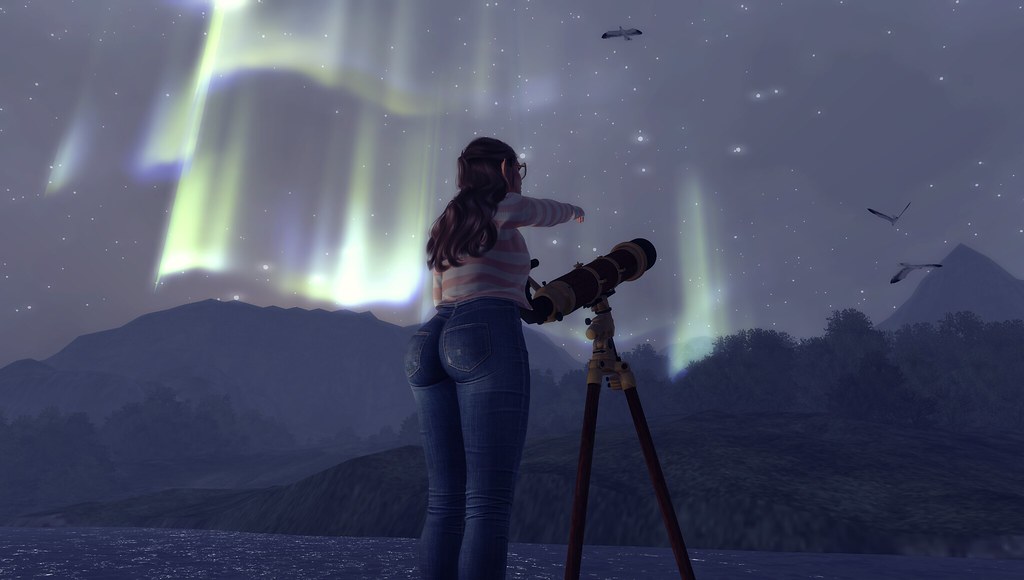
In many TNC member locations, nature creators recreate something we are slowly losing in the real world: true night skies filled with stars, moonlight, and quiet darkness. These spaces are more than aesthetic. They are a reminder of what night used to feel like, and what it can still be.
The next time you find yourself in one of those places, take a moment to look up. Let it ground you in both wonder and awareness.
Back on Earth
The Artemis II crew showed us something powerful: the Milky Way in its full, unfiltered glory. It’s a reminder of how vast the universe is, but also how fragile our view of it can be.
The night sky isn’t just scenery. It’s part of the living world we belong to.
It belongs to all of us. And it’s worth protecting.
Nerdy for Nature is a blog segment by Emm Evergarden, founder of The Nature Collective SL, sharing nature stories and reflections from the natural world and beyond.
“You can’t take the sky from me.”
One of the most striking things about the Artemis II crew observations were Mission Specialist Koch, describing earth as a tiny, fragile lifeboat, surrounded by vast blackness. It reminded me of Carl Sagan’s words about the ‘pale blue dot,’ inspired by photographs from the Voyager crafts. These are both reminders of how small we are, and it is incredibly humbling.
However, our collective impact on this lifeboat is immense. Going back to the original topic, I used to live in the Los Angeles area. Every time there is a major blackout, there are calls to the authorities, reporting the “weird glow in the sky.”
Which is a fascinating and sad reaction to seeing the Milky Way for the first time.
Dark sky parks are vital, as is managing light pollution in general, not only for the reasons stated in the post, but for the soul of humankind. The path of the ancestors, of a thousand stories and myths and hopes and dreams, is so difficult to find for many of us.
A concerted effort should be made to restore it.
I will admit I have not seen the night sky properly since I was a kid. The Artemis II mission did bring to mind the sights we used to enjoy. I would need to travel to the deep countryside to experience a moment of what it once was, but even then.. there is alota light pollution in the countryside now. This has made me think…