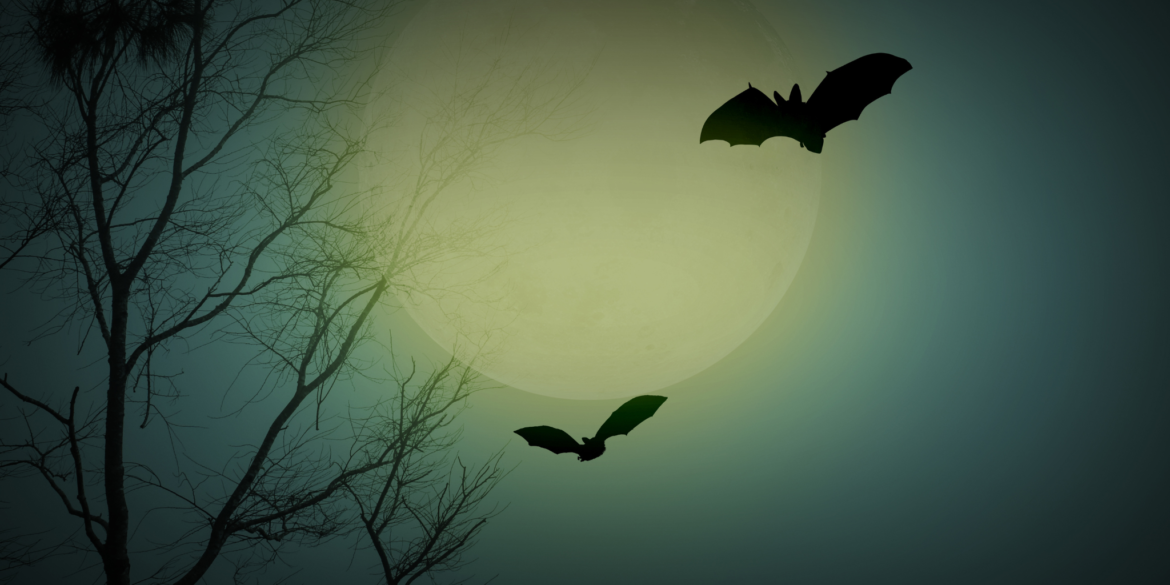
When you think of October and spooky season, it’s hard not to think of bats and their silhouette against a glowing October moon. We hang bat decorations from porches. We turn them into spooky little cartoons with pointy ears and tiny fangs. But somewhere along the way, we forgot that the real thing is much more interesting. Because while we’re busy putting bats on our Halloween decorations, actual bats are out there working the night shift.
More Than Just a Halloween Decoration
There are more than 1,400 species of bats around the world, making bats one of the most diverse groups of mammals on Earth. They live on every continent except Antarctica, and they come in an almost ridiculous variety of shapes, sizes, diets, and lifestyles. The smallest would fit in the palm of your hand, while the biggest have wingspans measured in feet. Menus range from insects to fruit, nectar, fish, and frogs. And only three species are vampire bats. So if your mental picture of a bat is basically “tiny Dracula,” you’re missing about 99.8% of the story.
The Night Shift
As the sun goes down, bats wake up. For many insect-eating species, this is when the real work begins. They head out from their roosts and start hunting moths, beetles, flies, mosquitoes, and other insects. And they are remarkably good at it.
Bats use echolocation to navigate and hunt in the darkness. They produce high-frequency sounds, often far above the range of human hearing, and listen for the echoes bouncing back from objects around them. Those echoes give them information about where something is, how far away it is, and whether it might be dinner. Think of it as biological sonar. Except instead of sitting in a submarine, you’re flying through the night while shouting into the darkness with your face.
Nature is weird. We love that.
And here’s another myth debunked: bats aren’t blind. They have functioning eyes and can see. Echolocation is an additional sensory superpower, not a replacement for vision. In fact, some bats rely heavily on sight and smell, particularly fruit and nectar feeding species.
Mosquitoes Are the Small Print
The “bats eat mosquitoes” line sells them short. Mosquitoes can certainly be on the menu, but many insect-eating bats go after moths, beetles, and other insects that damage crops and forests. Research has shown that bats provide significant natural pest-control benefits, helping reduce the number of insects that farmers would otherwise have to manage in other ways.
Not every bat works the same shift, either. Some species forage high above the ground, others skim over water, some hunt through forests, and others specialize in catching insects close to the ground. Every species has its own preferred habitat and its own particular way of making a living.
Some Bats Are Gardeners
In tropical and subtropical regions, many bats feed on fruit, nectar, and pollen, which makes them important pollinators and seed dispersers.
Some flowers have even evolved specifically to attract bats. These flowers may open at night, produce abundant nectar, and have shapes that make them easier for bats to locate. Some bat-pollinated flowers even have structures that make their echoes easier for bats to detect.
Fruit-eating bats can carry seeds long distances, helping plants spread and forests regenerate. Some of the plants that benefit from bat pollination are culturally and economically important too. In the American Southwest and Mexico, bats and agaves have a particularly fascinating relationship. Nectar-feeding bats visit agave flowers and help pollinate them as they move from plant to plant.
The Trouble With Being a Bat
For all their remarkable adaptations, bats are facing some very serious challenges. Habitat loss, disturbance of roosting sites, pesticide use, climate change, and other pressures can affect bat populations. In North America, one of the most devastating threats has been white-nose syndrome, a disease caused by the fungus Pseudogymnoascus destructans. The disease affects hibernating bats, disrupting their ability to conserve energy through the winter. Since it was first documented in New York in 2006, white-nose syndrome has killed millions of bats across North America.
The impacts have been especially severe for some species. Populations of northern long-eared bats, little brown bats, and tri-colored bats have experienced declines of more than 90 percent in areas affected by the disease. That number is sobering, but scientists are studying the disease, monitoring bat populations, and developing new ways to protect vulnerable species. Ordinary people can help, too.
Making Room for the Night Shift
Habitat doesn’t stop mattering when the sun goes down. Native plants support the insects that many bats depend on. Protecting trees and natural areas can provide places for bats to roost. Reducing unnecessary outdoor lighting can help preserve darker, more natural nighttime environments. If you are lucky enough to see bats swooping through the evening sky, let them do their thing.
Many summer evenings, you’ll find me out on the patio at dusk with a glass of iced tea in my hand, waiting for the first bats to flicker across the darkening sky.
So This Halloween…
We’ll probably keep hanging bat decorations from our porches, because bats really are perfect for the season. But maybe this October, when you see that little black silhouette flying across a moonlit sky, think about the animal behind the decoration.
One night a while back, I watched a bat slip out of its roost between the deck roof and the siding, slowly waking up as it headed off to work. I wished it a good shift and went back to my iced tea.
Nerdy for Nature is a blog series by Emm Evergarden, founder of The Nature Collective SL, dedicated to exploring the wonders of the natural world. Through nature facts, conservation topics, and stories from the wild, Emm hopes to inspire curiosity, encourage learning, and empower readers to make a positive difference for nature in their everyday lives.